THE CHESS BOOK
Rules of Chess
Starting Position Rules:
Chess is one of the greatest games to have ever existed and is played by hundreds of millions of people all around the world.
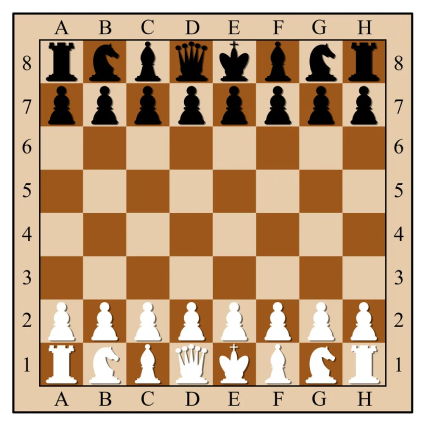
Chess is a game where two opponents play against each other on an 8×8 checkered board with a light square in each player’s lower right corner. Each play takes turns making one move with the player with the White pieces moves first.
Each game starts in the position shown in the example below. Each player starts with 1 King, 1 Queen, 2 Rooks, 2 Bishops, 2 Knights and 8 pawns. Notice that the Queens are placed on their own corresponding color next to the Kings on the center files.
Each player must make a move and a move cannot be skipped either.
The goal in the Chess is to checkmate the opponent’s King or for an opponent to run out of time. If either happens, you win.
Chess piece rules
The first section of rules is on how the Chess pieces move. Some Chess hustlers try and move a piece in a way in which it’s not supposed to be able to move hoping the opponent won’t catch it. It happens.
In this section, we’ll go over all the Chess piece moves by showing you all the ways in which each Chess piece can move.
Chess King rules
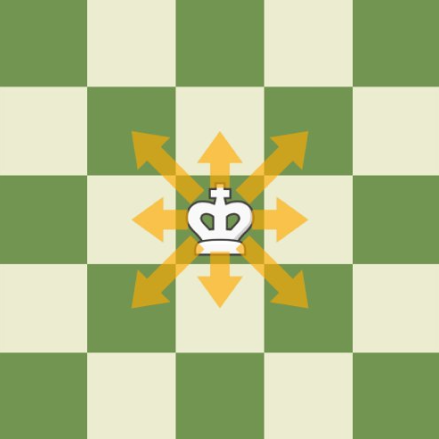
The King can move just one square in any direction. This makes the King a powerful piece in the endgame. The King can capture pieces as long as that piece isn’t being defended as you can’t put the King in check. See the guide on removing the defender for more information.
The Chess board below illustrates how the King moves. The King can move in the direction of the arrows moving to the squares the arrows are pointing too.
There is a special move involving the King called castling. This is the only move in Chess that actually involves two pieces at the same time, the other piece being the Rook.
Chess Rook rules
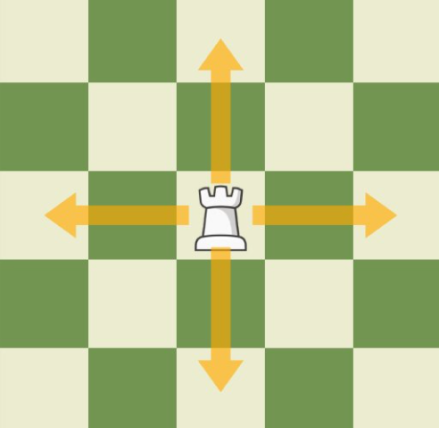
The Rooks can move any number of squares horizontally or vertically in a straight line, up until there is a piece blocking the Rook as it cannot jump over a piece. The Rook captures enemy pieces by placing the Rook on the same square the enemy piece was on.
In the special move mentioned above, castling, two pieces, the King and the Rook, are moved at the same time. For more information, see the guide on castling in Chess.
The Chess board below illustrates how Rooks move. The Rook can move in the direction of the arrows moving to the squares the arrows are pointing too.
Chess Bishop rules
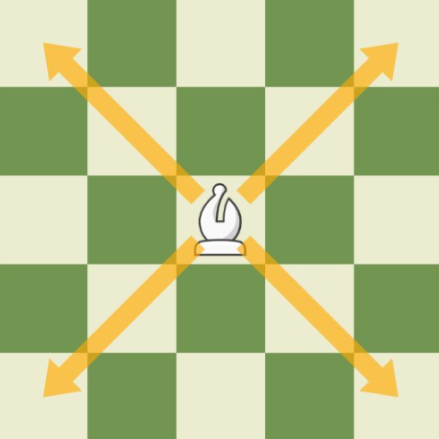
The Bishop can move any number of squares diagonally as long as a piece isn’t blocking the diagonal the Bishop is moving on as Bishops cannot jump over another piece.
At the start of the game, each player has two Bishops, a Bishop on a White square and a Bishop on a black square. So each player has a light squared Bishop that will always remain on the light squared diagonals and a dark squared Bishop that will always remain on the dark squared diagonals.
The Chess board below illustrates how Bishops move. The Bishop can move in the direction of the arrows moving to the squares the arrows are pointing too.
Chess Queen rules
The Queen is the most mobile piece, not the most valuable as the King is the most valuable, but the most mobile and most powerful piece.
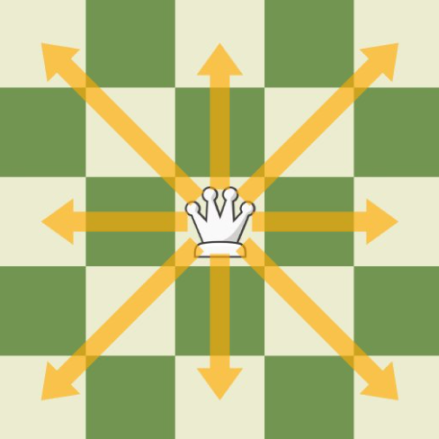
The Queen has the capability of both the Rook and the Bishop. Queens can move any number of squares horizontally, vertically, and diagonally. The same rules for the Rook and Bishop apply to the Queen, it cannot jump over another piece.
The Chess board below illustrates how the Queen moves. The Queen can move in the direction of the arrows moving to the squares the arrows are pointing too.
Chess Knight rules
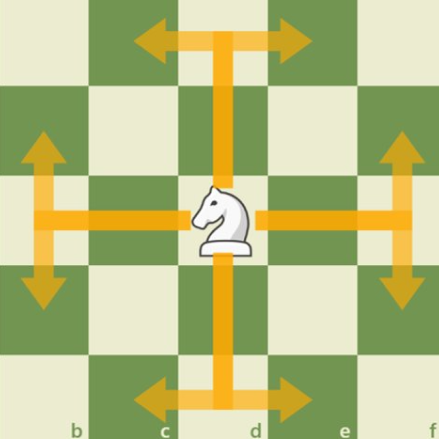
The Knight has the most unique way of moving on the Chess board. The Knight is the only piece on the board that can jump over other pieces, friendly or opponents. The way in which is moves is commonly described as moving two squares horizontally and one square vertically, or two squares vertically and one square horizontally. The Knight can move to any of the outer opposite colored squares of the 5 by 5 around the square the Knight is currently on.
The Chess board below illustrates how the Knight moves. The Knight can move in the direction of the arrows moving to the squares the arrows are pointing too.
Chess Pawn rules
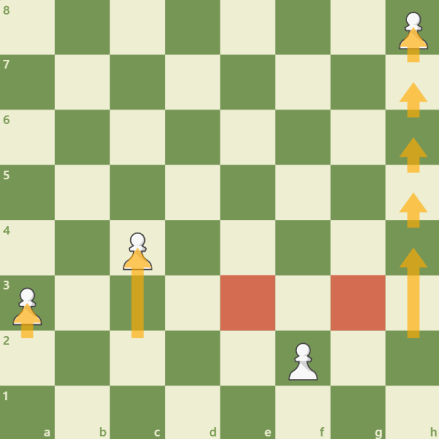
Pawns being the weakest piece in Chess, with a value of 1, are only allowed to only move one square forward at at time. However, in the first move of that specific pawn, the pawn can move one square or two squares forward.
They cannot move in any other way except forward unless they are capturing a piece. Pawns capture pieces by moving one square diagonally and land on the square of the piece they just captured. There is only one exception to this and the only other way a pawn can move on the board. It’s a special move called, En Passant, but we’ll cover that separately in a section further down on this page.
The Chess board below illustrates how Pawns move. The Pawn can move in the direction of the arrows moving to the squares the arrows are pointing too.
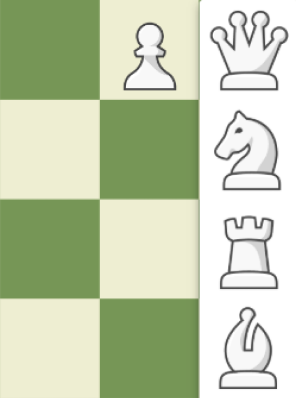
If a pawn makes it to the back rank, the end of the board, the pawn is then promoted and replaced with any piece of your choosing, including a Knight, Bishop, Rook, or a Queen. Any piece excluding another King. Pawns are promoted to a Queen in the majority of cases. Since the Knight can move in such a unique way, sometimes the pawn is promoted to a Knight which could be more advantageous depending on the position. You could even checkmate an opponent by promoting to a Knight, or another piece for that matter.
Special Chess rules
En passant rules
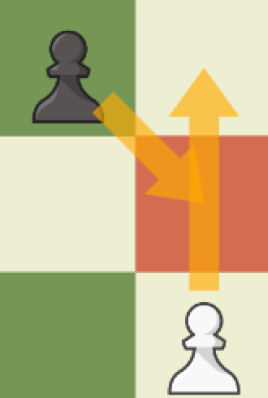
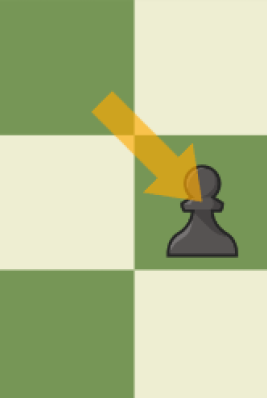
En Passant is a special move in Chess that allows a pawn to capture another pawn that has moved forward two squares on that pawns first move and lands one square next to an enemy pawn.
If this occurs, the player is able to capture that pawn with your pawn via En Passant on the next move and only the next move. The pawn captures the pawn by moving one square forward diagonally above the pawn, capturing the pawn. So it’s the only move in the entire game of Chess where a piece is captured by not landing directly on the square of the piece being captured. See the example below.
Castling rules
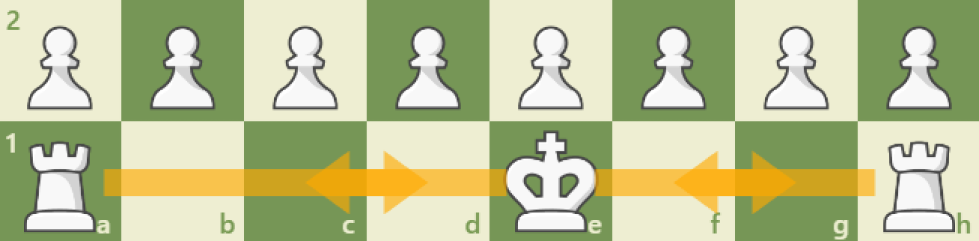
Castling is a special move in Chess that allows the player to move two pieces in one move, the two pieces being the King and the Rook. The purpose of this move is to remove the King from the center of the board and into a more safe position. You cannot castle at any point in time though, a player can only castle when the following circumstances are met.
The King is not currently in check prior to castling, the Rook can be attacked prior to castling, but not the King.
- The King is not in check on the square the King would be on after castling
- The King is not in check on any of the squares the King passes through while castling
- The King and the Rook involved have not moved yet during the game
- All of the squares in between the King and the Rook are unoccupied by another piece
One final rule about the moves of Chess pieces. According to the official rules a piece that has been touched has to be moved. A move is completed as soon as the piece has been released and may not been taken back.