THE CHESS BOOK
Strategies
In this section, we will explore not just one simple chess strategy but three principles that beginners can use to improve their game.
Principle of Least Active Piece
Chess is a complex game with countless strategies and tactics to master. However, one of the most fundamental principles is the Principle of the Least Active Piece. This principle is not only useful for beginners, but also for more experienced players. It provides a clear goal for each move and helps to simplify the decision-making process.
The Principle of the Least Active Piece is based on the idea that each piece on the board has a specific function and potential. Some pieces are more active than others. This means that they have a greater impact on the game and are more actively involved in the action. Conversely, some pieces are less active, meaning that they are not contributing as much to the game. Hence, they are not fulfilling their potential.
To apply this principle, players must first identify their least active piece. This could be a piece that has not moved, a piece that is poorly placed, or a piece that is not contributing to the game in any significant way. Once the least active piece has been identified, the player must work to improve its position or activity level.
Improving the activity of a piece can take many forms. For example, a player could move a rook to an open file or rank, move a bishop to an open diagonal, or advance a pawn to gain space and open up lines for their pieces. The key is to find a move that improves the activity of the least active piece while also advancing the overall position.
In this example below, you can see that the black rook is more active than the white rook
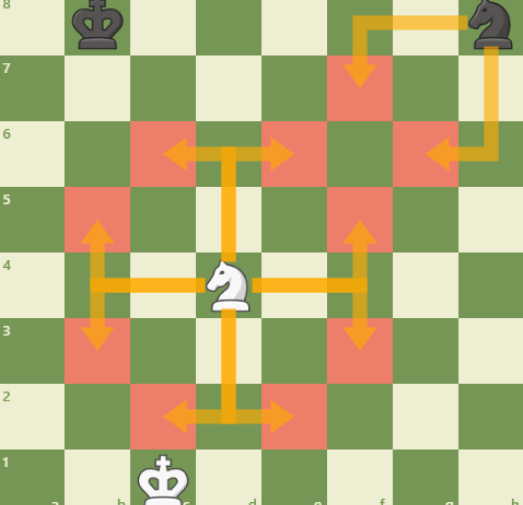
Here is another example about how the white knight controls 8 squares while the black knight only controls 2 squares
Be careful!
It is worth noting that the Principle of the Least Active Piece is not a hard and fast rule. There may be situations where it is not the best approach, or where other factors come into play. Nevertheless, it is a useful principle to keep in mind, particularly for beginners who are still developing their chess skills.
In conclusion, the Principle of the Least Active Piece is a fundamental chess strategy that can help players of all levels to simplify the game and make more effective moves. By identifying and improving the activity of their least active piece, players can work towards a clear goal.
Principle of Flexibility
One of the key principles of chess strategy is the principle of flexibility. This is based on the idea that it’s better to keep one’s options open rather than committing too early to a specific plan.
The principle of flexibility can be seen in the opening phase of the game. In this phase, players make their first moves and try to control the center of the board. The principle of flexibility encourages players to make moves that don’t commit them to a specific plan. But rather leave them with several options to choose from.
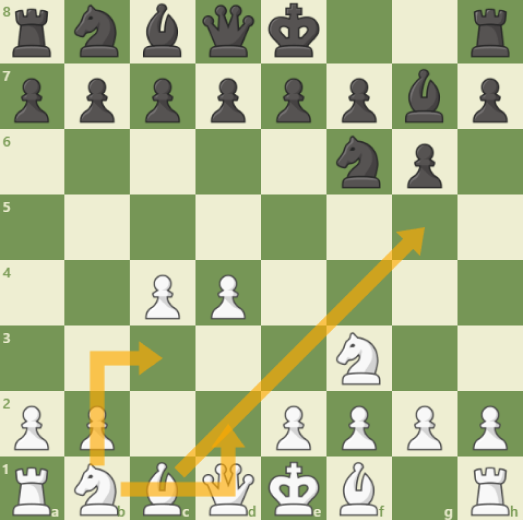
For example, in this position, we know for sure that the knight needs to be placed on c3. This leaves us with the question of where to develop the dark-squared bishop.
We can postpone this decision because we know that we need to castle and we need to bring out our light-squared bishop first.
If we play Bg5 first, defining the position, Black can attack the bishop and change the nature of the position. Also if we play Nd2, we block our own bishop and do not defend the central squares.
Instead, the principle of flexibility suggests that White should consider moves like Nc3 , which develop pieces and control the center, but also leave White with more options for the future. These moves allow White to wait and see how Black responds before committing to a specific plan.
Principle of Not Creating Weaknesses
One important concept in chess is the principle of avoiding creating weaknesses unless it is really needed. This principle emphasizes the importance of being cautious when making moves that could potentially weaken one’s position on the board.
In chess, a weakness refers to a square or a piece that is vulnerable to attack or capture. It is important to avoid creating weaknesses in one’s position because they can be exploited. Weaknesses can also limit one’s mobility on the board, making it difficult to launch an effective attack or defense.
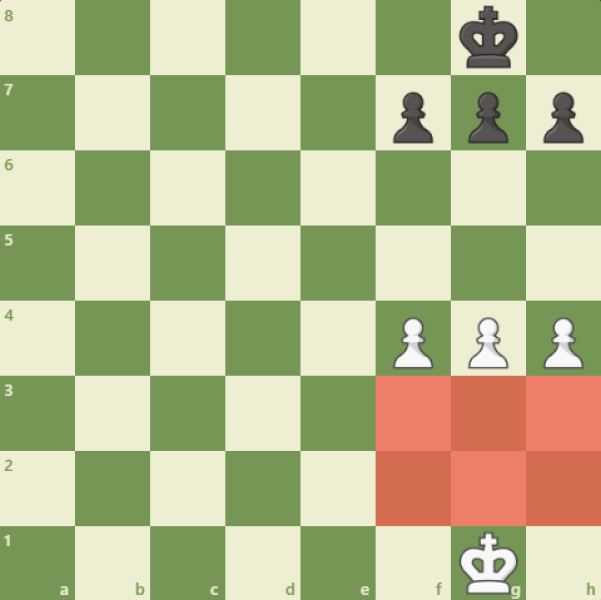
One common example of creating a weakness in chess is moving pawns in front of one’s king. Pawns are the weakest pieces on the board, and they are also the first line of defense for the king. Moving a pawn in front of the king can weaken the king’s position, as it opens up diagonal lines of attack for the opponent’s pieces.
This can be particularly dangerous if the opponent has a bishop or a queen that can quickly target the weakened square in front of the king. However, there are situations where it may be necessary to create weaknesses in one’s position in order to achieve a specific goal.
For example, if one is trying to launch an attack on the opponent’s king, it may be necessary to advance pawns in front of one’s own king to create a pathway for the queen or other attacking pieces. In this case, the benefits of the attack may outweigh the risks of creating a weakness in one’s own position.